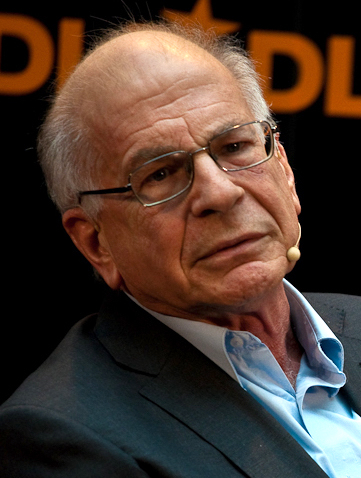
.jpg)
1934 to 2024, Israel and USA · Cognitive psychologist; founder of behavioural economics
Also known as: Daniel Kahneman
Daniel Kahneman, with Amos Tversky, mapped the systematic departures of human judgement from the predictions of expected-utility theory, and won the Nobel Memorial Prize in Economics in 2002 (Tversky had died in 1996 and was therefore not eligible). The Kahneman-Tversky programme catalogued heuristics and biases: anchoring, availability, representativeness, framing, loss aversion, and the planning fallacy, each documented with carefully controlled experimental designs.
His 2011 book Thinking, Fast and Slow gave the resulting framework its working vocabulary of System 1 (fast, automatic, intuitive) and System 2 (slow, effortful, deliberate). The framework has shaped behavioural economics, public policy nudges, medical decision-making and the user-experience literature on choice architecture. Kahneman's Noise (2021), with Olivier Sibony and Cass Sunstein, extended the analysis from systematic bias to random variability in expert judgement.
Related people: Amos Tversky, Herbert Simon
Works cited in this book:
- Judgment under Uncertainty: Heuristics and Biases (1974) (with Amos Tversky)
- Thinking, Fast and Slow (2011)
Discussed in:
- Chapter 4: Attention and Decision-Making (Heuristics and Biases)
- Chapter 4: Attention and Decision-Making (System 1 and System 2)