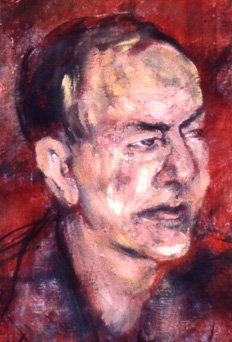

1916 to 2001, USA · Cognitive scientist, economist, and computer scientist
Also known as: Herbert A. Simon
Herbert Alexander Simon is one of the few scholars to win both the Nobel Memorial Prize in Economics (1978) and the ACM Turing Award (1975, with Allen Newell). Across economics, psychology, computer science, public administration and philosophy he argued that human decision-making is shaped not by perfect optimisation but by cognitive limits, time pressure and incomplete information; his term satisficing captures the resulting strategy of accepting the first option that is good enough.
His book The Sciences of the Artificial (1969, third edition 1996) is the foundational text on design as a science. Simon argued that design (the process of devising artefacts to attain goals) deserves the same rigorous, formal treatment as the natural sciences, and that it can be taught with theorems, optimisation and search. The argument is the philosophical backbone of every chapter of this textbook, including the closing claim that there can be a science of design rather than a craft of taste.
Related people: Allen Newell, Daniel Kahneman
Works cited in this book:
- Rational choice and the structure of the environment. (1956)
- The Sciences of the Artificial (1969)
- Human Problem Solving (1972) (with Allen Newell)
- Perception in chess (1973) (with William G. Chase)
- How big is a chunk? By combining data from several experiments, a basic human memory unit can be identified and measured (1974)
- Protocol Analysis: Verbal Reports as Data (1984) (with Joseph H. Danks, K. Anders Ericsson)
- Protocol Analysis; Verbal Reports as Data (Revised ed) (1993) (with K. Anders Ericsson)
- The Sciences of the Artificial (1996)
Discussed in:
- Chapter 4: Attention and Decision-Making (Bounded Rationality and Satisficing)
- Chapter 20: Towards a Science of Design (Design as a Science)