
Every designed object (a door handle, a cockpit instrument panel, a hospital information system, a city street) mediates between a human being and a goal. When the mediation is seamless we barely notice it; when it fails the consequences range from mild frustration to serious harm. Usability is the discipline concerned with understanding and improving the quality of that mediation. This textbook presents usability as an applied science. Its foundations lie in experimental psychology, human factors engineering, and architecture, fields that have spent decades measuring human perception, cognition, and motor performance. From those measurements a set of quantitative laws and predictive models has emerged (Fitts's Law for pointing movements Fitts, 1954, Hick's Law for choice reaction time Hick, 1952, Miller's capacity limits for working memory Miller, 1956) that allow designers to evaluate and compare designs without relying solely on intuition or post-hoc testing Card, 1983. Alongside these scientific models, centuries of evolved design practice in architecture, aviation, and other industries provide tested heuristics that complement the experimental evidence [Norman, 2013; Alexander, 1977].
- Define usability and distinguish it from related concepts such as user experience
- Explain why usability matters in safety-critical domains
- Describe the ISO 9241 framework for usability
- Outline the structure and scope of this textbook
- Understand the case for a scientific approach to design
Defining Usability
The International Organization for Standardization defines usability as the "extent to which a system, product or service can be used by specified users to achieve specified goals with effectiveness, efficiency and satisfaction in a specified context of use" Standardization, 2018. Three components are central to this definition NIELSEN, 1993.
Effectiveness is the accuracy and completeness with which users achieve their goals. A medication ordering system is effective if the correct drug, dose, and route reach the patient; a wayfinding system is effective if visitors reach their destination without getting lost.
Efficiency concerns the resources expended in relation to the results achieved. Time is the most common measure (how long does it take a nurse to document a set of vital signs?), but cognitive effort, physical effort, and error recovery costs are equally relevant.
Satisfaction captures the user's subjective response: comfort, trust, and willingness to use the system again. A technically efficient interface that leaves users anxious or confused has a usability problem, even if task completion rates are high.
The power of the ISO definition lies as much in its three qualifiers as in its three components. Usability is defined for "specified users", "specified goals", and a "specified context of use", and each of those words is doing real work. A radiology workstation that an experienced consultant finds fluid may overwhelm a newly qualified registrar, so the specified user population determines what "usable" even means. A spreadsheet that is excellent for financial modelling may be a poor tool for writing a letter, so the specified goal bounds the claim. And a touchscreen that performs well on an office desk may be unusable in an ambulance, where vibration, gloves, glare, and divided attention change the context entirely. Because all three qualifiers must be fixed before usability can be measured, there is no such thing as an interface that is usable in the abstract. The practical consequence is that every usability claim, and every usability test, must name its users, their goals, and the conditions under which they will work; a result obtained with one combination does not automatically transfer to another.
This relativity also explains why two seemingly contradictory evaluations of the same product can both be correct. A flight booking site may score well in effectiveness and efficiency for a frequent traveller booking a familiar route, yet fail badly for an occasional user buying a complex multi-leg ticket. The interface has not changed; the specified user and goal have. Rather than asking whether a design "is usable", the discipline asks the sharper question of whether it is usable enough, for whom, doing what, and where.
Usability is not a single property but a relationship between a user, a task, and a context. The ISO definition is explicit on this point: effectiveness, efficiency, and satisfaction are always measured for specified users pursuing specified goals in a specified context of use. The same interface may be highly usable for an expert performing a routine task and unusable for a novice encountering it for the first time. Evaluation must always specify who the users are, what they are trying to do, and under what conditions, because usability is relative to a context and is never absolute.
Usability, User Experience, and Accessibility
Usability is sometimes used loosely as a synonym for two broader ideas, but precision matters and the three are not interchangeable. User experience (UX) is the wider concept. The companion standard ISO 9241-210 defines it as a person's perceptions and responses resulting from the use, or anticipated use, of a product or service Standardization, 2019. UX therefore includes everything usability covers, but also reaches into emotion, anticipation, brand perception, aesthetic pleasure, and the meaning a product holds in a user's life. A ticket machine can be highly usable (fast, accurate, learnable) and still deliver a poor experience if it feels impersonal or anxiety-inducing; conversely a product can be loved despite rough edges in its usability. Hassenzahl's influential account distinguishes the pragmatic qualities of a product, which map closely onto usability, from its hedonic qualities, which concern stimulation, identity, and pleasure and lie outside the ISO usability triad Hassenzahl, 2010. Garrett's layered model of UX similarly places usability concerns (the structure, skeleton, and surface of an interface) within a larger frame that begins with strategy and user needs Garrett, 2010. Usability, in short, is a necessary component of good UX but not a sufficient one.
Accessibility is narrower and more specific: it is the degree to which a product can be used by people with the widest range of abilities, including those with visual, motor, auditory, or cognitive impairments. The Web Content Accessibility Guidelines organise this goal around four principles, requiring that interfaces be perceivable, operable, understandable, and robust Initiative, 2018. Accessibility and usability overlap heavily, because a design that fails for a screen-reader user or for someone who cannot use a mouse has a usability failure for that specified user population. Yet they are not identical. A page can be technically accessible (every image carrying alternative text, every control reachable by keyboard) while still being slow, confusing, and frustrating to operate. The most defensible position treats accessibility as usability for the full diversity of human ability, and treats both as ingredients of a good overall experience. This textbook concentrates on usability, but returns to accessibility wherever specified users include people whose perceptual or motor capabilities differ from the assumed norm.
Why Usability Matters
Poor usability is not merely an inconvenience. In healthcare, confusing drug selection interfaces have contributed to medication errors. In aviation, cockpit display designs that exceeded pilots' cognitive capacity played a role in accidents. In architecture, buildings that disorient their occupants create stress and reduce productivity.
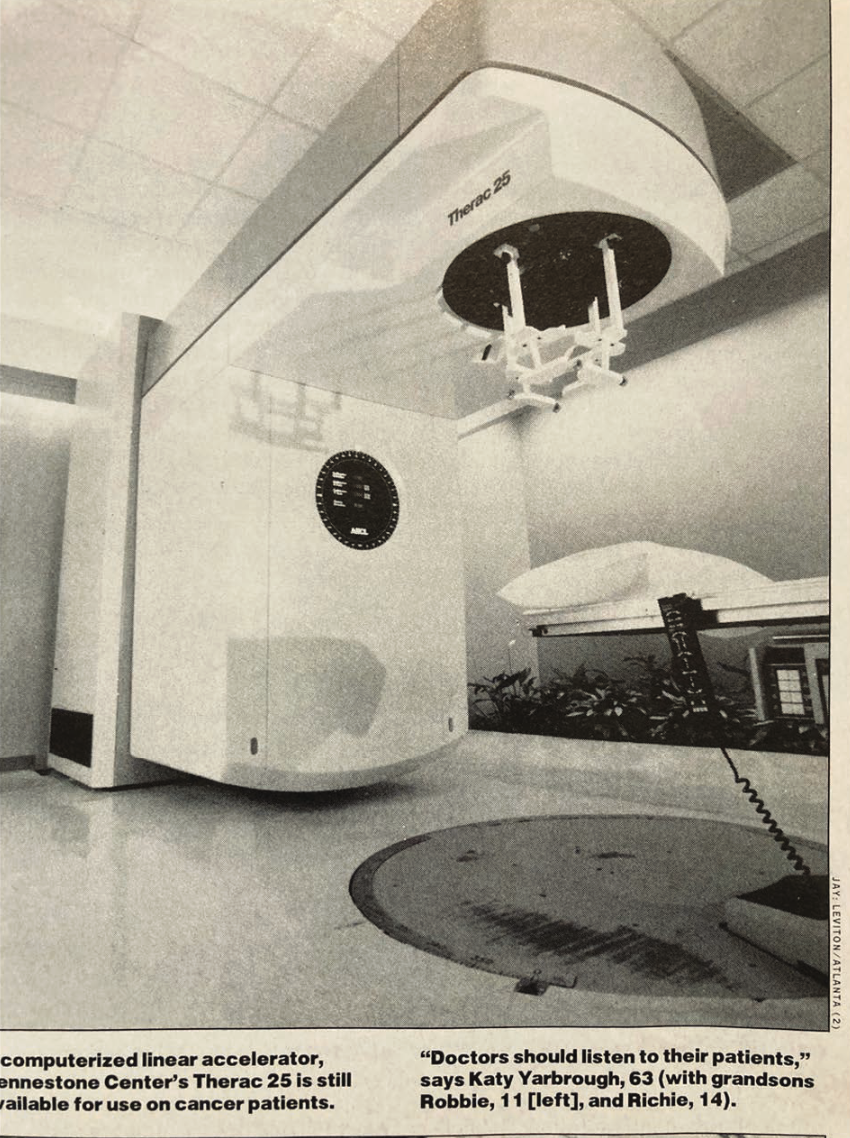
Between 1985 and 1987, at least six patients receiving treatment from the Therac-25 radiation therapy machine were subjected to massive radiation overdoses, delivering up to a hundred times the intended dose Leveson, 1993. At least three died as a direct result of their injuries; others suffered severe burns and permanent disability. The accidents were not caused by a single faulty component but by an interaction between two design decisions. A software race condition, triggered by an operator editing parameters quickly at the terminal, could leave the machine configured to deliver a high-energy electron beam without the protective beam-spreading target in place. In earlier models (the Therac-6 and Therac-20) a hardware interlock would have physically prevented the beam from firing under those conditions. For the Therac-25, the manufacturer had removed the hardware interlock and relied entirely on software to enforce safety. When the software failed, nothing else caught it; worse, the operator console displayed only a cryptic "Malfunction 54" error that gave the user no indication that a lethal dose had just been delivered. The Therac-25 is the single most-cited case study in safety-critical software engineering, and it will recur throughout this textbook as a touchstone for the argument that interface design, error reporting, and hazard analysis are not separate concerns from "real" engineering; they are at the heart of what makes a system safe.
The cost of poor usability extends beyond individual incidents. Organisations lose productivity when employees struggle with internal software. Products fail in the marketplace when customers find them difficult to learn. Public services lose trust when citizens cannot navigate online systems. In each case the root cause is a mismatch between the demands of the design and the capabilities of the human beings who must use it.
These costs compound over time, and crucially they grow the later a problem is caught. A usability flaw discovered while sketching on paper costs a few minutes to redraw. The same flaw discovered in a working prototype costs a developer's time to recode. Discovered after release, it costs a support team fielding repeated complaints, a sales team explaining the awkwardness to prospective customers, and eventually an engineering team retrofitting a fix into a shipped product that real users now depend on. This is why a recurring theme of usability engineering is that problems are far cheaper to find and fix early, before code and expectations have hardened around the flawed design. The same logic motivates evaluating designs continuously rather than only at the end, and it underpins the formal models of evaluation cost and yield that we examine in Part IV Nielsen, 1993.
Consider an internal expense-claim tool used by every employee in a large organisation. Suppose a usability test reveals that the average claim takes twelve minutes to submit, with a third of submissions rejected for missing information and resubmitted. A redesign that clarifies the labels, validates fields as the user types, and removes two redundant screens might bring the average down to seven minutes and cut the rejection rate to one in ten. The arithmetic is unforgiving in the organisation's favour. If five thousand employees each file two claims a month, shaving five minutes from each submission and eliminating most resubmissions recovers thousands of working hours a year, all from a single, bounded redesign. No new feature was added; the gain came entirely from removing friction that the original design had imposed. This pattern, in which measurable reductions in task time and error rate translate directly into recovered productivity, is the everyday business case for usability, and it is precisely the kind of improvement that controlled before-and-after measurement (Part IV) is designed to detect Sauro, 2016.
A Scientific Approach to Design
This textbook argues that design need not be solely a matter of taste, intuition, or iterative trial and error. The human body and brain have measurable properties (the speed of visual processing, the capacity of working memory, the time required to move a hand to a target) and these properties constrain what designs will and will not work.
Fitts's Law Fitts, 1954 states that the time required to move to a target is a logarithmic function of the distance to the target divided by the target's width. This law, derived from information theory and confirmed by decades of replication, provides a quantitative basis for sizing and positioning interactive elements MacKenzie, 1992.
Not all useful design knowledge comes from controlled experiments. The architectural principles of Vitruvius Pollio, -30, written in the first century BCE, codify observations about proportion, symmetry, and human comfort that have been validated by two millennia of practice. Andrea Palladio's Four Books of Architecture Palladio, 1570 formalised rules for room proportions that still influence building design. These evolved practices represent a different kind of evidence (observational rather than experimental) but one that is no less valuable for being older Simon, 1996. The chapters that follow are arranged to build this argument from the ground up. We begin with Foundations (Part I), the human perception, memory, attention, and motor systems whose measurable limits constrain every design. We then turn to Laws and Models (Part II), where those limits are formalised into quantitative tools such as the Model Human Processor, GOMS, and Fitts's Law, together with the heuristic frameworks and architectural laws that complement them. Domains of Application (Part III) shows how the general principles take concrete form in software, healthcare systems, the built environment, and data visualisation, each of which bends the principles to its own constraints. Methods (Part IV) supplies the practical toolkit for putting these ideas to work and for measuring whether a design actually succeeds: usability testing, expert review, predictive modelling, and experimental design. Finally, The Future (Part V) examines how artificial intelligence is reshaping both the practice of design and its evaluation, and restates the case for treating design as a cumulative, evidence-based science. A reader can follow this arc in order, or treat the foundations and methods as reference material to return to while reading a domain chapter of immediate interest.
Structure of This Textbook
Part I: Foundations (Chapters 2 to 5) covers the human systems that constrain design: perception, memory, attention, and motor control. Each chapter introduces the relevant psychology and connects it to design implications.
Part II: Laws and Models (Chapters 6 to 10) presents the quantitative models and heuristic frameworks that translate human science into design guidance, from the Model Human Processor and GOMS to design heuristics and the laws of architecture and aviation.
Part III: Domains of Application (Chapters 11 to 14) examines usability in specific contexts (software, healthcare systems, the built environment, and data visualisation) where the general principles take on domain-specific forms.
Part IV: Methods (Chapters 15 to 18) covers the practical toolkit for evaluating usability: testing with users, expert review, predictive modelling, and experimental design.
Part V: The Future (Chapters 19 to 20) considers how artificial intelligence is changing both the practice of design and the evaluation of usability, and makes the case for treating design as a cumulative, evidence-based science.
Key Takeaways
- Usability is defined by the ISO 9241 triad of effectiveness, efficiency, and satisfaction, always relative to specific users, tasks, and contexts.
- Poor usability has measurable costs in safety, productivity, and trust.
- Human perception, cognition, and motor performance have quantifiable properties that constrain design.
- Scientific laws (Fitts's Law, Hick's Law) and evolved design practices (architectural proportions) provide complementary sources of evidence for design decisions.
- This textbook presents usability as an applied science, integrating experimental evidence with centuries of design practice.
Further Reading
- Norman, D. A. (2013). The Design of Everyday Things (revised and expanded edition). Basic Books.
- ISO 9241-11:2018. Ergonomics of human-system interaction, Part 11: Usability: Definitions and concepts. International Organization for Standardization.
- Card, S. K., Moran, T. P., & Newell, A. (1983). The Psychology of Human-Computer Interaction. Lawrence Erlbaum Associates.
- Nielsen, J. (1993). Usability Engineering. Academic Press.
- Leveson, N. G., & Turner, C. S. (1993). An investigation of the Therac-25 accidents. Computer, 26(7), 18 to 41.