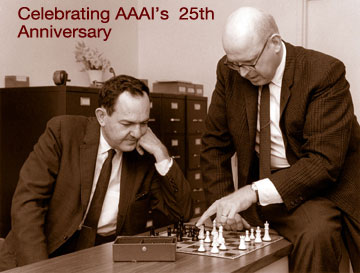

1927 to 1992, USA · Cognitive scientist; co-founder of artificial intelligence and cognitive science
Also known as: Allen Newell
Allen Newell, with Herbert Simon, founded the symbolic-AI tradition and shaped cognitive science in its first decades. The Newell-Simon collaboration produced the Logic Theorist (1956), the General Problem Solver (1959), and a long series of papers on problem-solving, expertise and production-system architectures.
In the 1980s Newell joined Card and Moran at Xerox PARC for the work that became The Psychology of Human-Computer Interaction, applying his architectural style of cognitive modelling to the design of interactive systems. His final book, Unified Theories of Cognition (1990), proposed Soar as a candidate unified architecture, an ambition that continues to motivate cognitive-architecture research. He won the ACM Turing Award with Simon in 1975 for "their joint scientific efforts in artificial intelligence, the psychology of human cognition, and list processing".
Related people: Herbert Simon, Stuart Card, Thomas Moran
Works cited in this book:
- Human Problem Solving (1972) (with Herbert A. Simon)
- The keystroke-level model for user performance time with interactive systems (1980) (with Stuart K. Card, Thomas P. Moran)
- Computer text-editing; an information-processing analysis of a routine cognitive skill (1980) (with Stuart K. Card, Thomas P. Moran)
- The Psychology of Human-Computer Interaction (1983) (with Stuart K. Card, Thomas P. Moran)
- The Psychology of Human-Computer Interaction (1983) (with Stuart K. Card, Thomas P. Moran)
- The Model Human Processor: An Engineering Model of Human Performance (1986) (with Stuart K. Card, Thomas P. Moran)
- Cumulating the science of HCI; from S-R compatibility to transcription typing (1989) (with Bonnie E. John)
- Unified Theories of Cognition (1990)
- Unified Theories of Cognition (1990)
Discussed in:
- Chapter 6: The Model Human Processor (The Model Human Processor)
- Chapter 7: GOMS and the Keystroke-Level Model (GOMS)