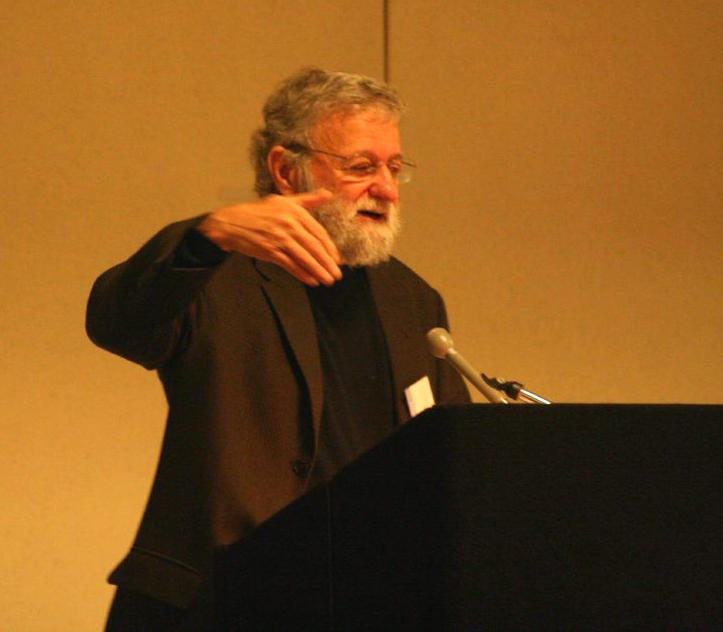

b. 1935, New York City · Cognitive scientist and design theorist; popularised user-centred design
Also known as: Don Norman, D. A. Norman
Donald Arthur Norman is the figure most associated with the modern, psychologically grounded view of design. Trained as an electrical engineer at MIT and as a mathematical psychologist at the University of Pennsylvania, he spent the bulk of his career at the University of California, San Diego, where he co-founded the Department of Cognitive Science.
His 1988 book The Psychology of Everyday Things, reissued in 1990 as The Design of Everyday Things, made the case that frustration with doors, light switches, taps and software is not user error but designer failure. The book gave the discipline its working vocabulary (affordances, signifiers, mappings, feedback, conceptual models, forcing functions) and established that observable usability problems can be diagnosed using the same cognitive psychology that explains perception, attention and motor control.
In the early 1990s Norman joined Apple as a User Experience Architect, a title he is widely credited with coining; the term "user experience" now denotes the full discipline that grew out of this textbook's subject matter. He later co-founded the Nielsen Norman Group with Jakob Nielsen, which continues to publish influential research on web and software usability. His later books, Emotional Design (2004) and Living with Complexity (2010), broaden the argument to cover affective response and systemic complexity.
Related people: Jakob Nielsen, Herbert Simon, Ben Shneiderman
Works cited in this book:
- On data-limited and resource-limited processes (1975) (with Daniel G. Bobrow)
- Categorization of action slips. (1981)
- Some observations on mental models (1983)
- Cognitive engineering (1986)
- The Psychology of Everyday Things (1988)
- The Invisible Computer; Why Good Products Can Fail, the Personal Computer Is So Complex, and Information Appliances Are the Solution (1998)
- Affordance, conventions, and design (1999)
- Emotional Design; Why We Love (or Hate) Everyday Things (2004)
- The Design of Future Things (2007)
- Living with Complexity (2010)
- The Design of Everyday Things (2013)
- The Design of Everyday Things; Revised and Expanded Edition (2013)
- Design for a Better World (2023) (with Jim Euchner)
Discussed in:
- Chapter 1: Introduction: What Is Usability? (A Scientific Approach to Design)
- Chapter 8: Design Heuristics and Guidelines (Norman's Design Principles)
- Chapter 16: Heuristic Evaluation and Expert Review (Heuristic Evaluation)